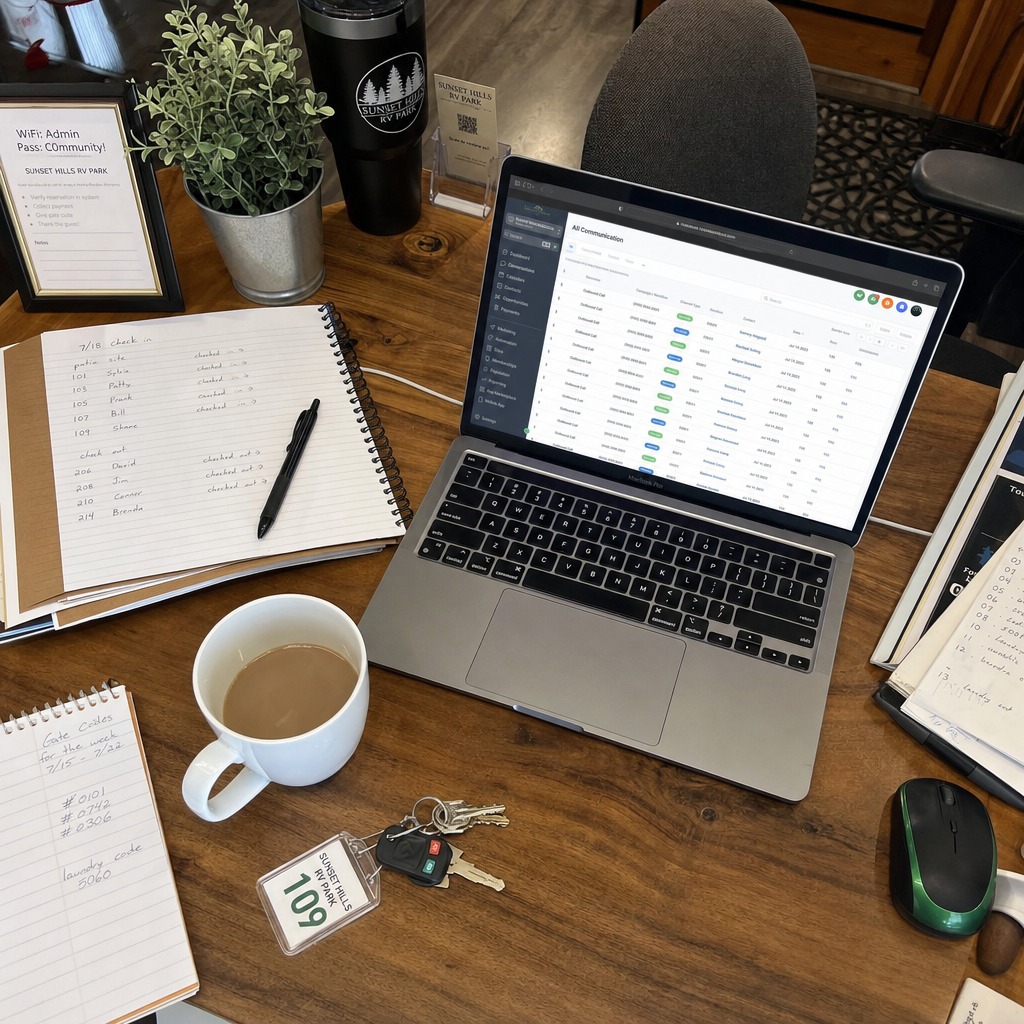
A resident calls Tuesday morning: "I never got that rent reminder you said you would send." You check your texts, your email, the Facebook messages, a handwritten note on the desk by the office window. Was it three days ago? Two weeks? Did you send it or just plan to?
Meanwhile, another resident is complaining about a water issue that he swears he reported last month. You have no idea if he actually told you or if you forgot. A third resident's payment cleared but you are not certain which notice he got, so you cannot remember if he still owes a late fee.
This is not chaos born from carelessness. This is what happens when you run a long term RV park with a phone in one hand and a walkie talkie in the other.
Long Term Parks Are Different
Nightly campgrounds turn inventory. RV parks and mobile home communities do not. Your residents stay for months or years. You learn their patterns. You remember that Sarah always pays a few days late, that unit 14 has chronic drainage issues, that the residents in the back row get along and the ones up front do not.
Because these are long term relationships, communication history matters. It is the backbone of how you run the park. But if that history is scattered across your personal phone, Gmail, Facebook messages, a sticky note, and your memory, you are constantly reinventing context instead of using it.
What Tenant Communication Records Are
Tenant communication records are simply a chronological account of what you said to each resident, what they said back, and when it happened. Nothing more. No resident app. No accounts to create.
Think of it as a notebook tied to each resident's name or site, but instead of losing pages or forgetting where you wrote it down, everything sits in one place tied to their record. Every message sent. Every reply received. Every date and time. Every topic. All findable in seconds instead of minutes of searching.
A tenant communication record is not extra office work. It is the park memory you can search when a resident asks, "What did we agree to?"
See the AcreRelay workflowWhy Scattered Communication Creates Problems
The moment you split resident conversations across five different places, you lose.
You lose follow up. You tell a resident a repair will happen Thursday but the message went through text and the confirmation came back on Facebook. When Friday arrives and the repair did not happen, you have no clean thread to review. Did he actually confirm? Did you say Thursday or did you say "by Friday"? You spend more time reconstructing what was said than fixing the actual problem.
You lose clarity on notice history. When a resident disputes a late fee, you need to show that you sent the rent reminder on time. If that reminder is somewhere in your email but the reply is a text and the follow up conversation was Facebook, you cannot quickly pull a clear timeline. You look disorganized and unprofessional.
You lose time. Every day you spend digging through texts, email, and notes is a day you are not managing the park. It is a day you are playing detective.
You lose handoff. When another staff member needs to help operate the park or when you are sick and someone else needs to take over, they inherit nothing. They have no conversation history. They have to start from scratch or bother you for context.
And you lose yourself in dependence on your personal phone. Everything lives on your personal device. If your phone breaks or you get a new one, the history is gone. If you lose your phone, the park loses its memory.
What Small Operators Should Track
You do not need to track everything. You need to track what helps you run the park professionally.

That is it. Not elaborate notes. Not full property management software. Just clear records tied to each resident so context is findable.
Practical Examples
A resident misses rent. You send a text reminder on the third of the month. He replies the same day saying he will pay by the tenth. He does not. You send a follow up on the fifteenth. He replies apologizing and says he will pay by next Friday. He does. Now when you are reconciling accounts, all three exchanges are in one place in chronological order. You know exactly what promises were made and when payment came through.
Another situation: a resident reports a maintenance issue through Facebook Messenger. You write it down but forget to actually put in a work order. Weeks later the resident calls upset. If those messages are scattered, you cannot show him that you are responding quickly. If they are in one record, you can see exactly when he reported it and when you actually acted.
A third: you decide to implement a new park rule about visitor parking. You need to notify all residents. Instead of texting some, emailing others, and knocking on doors hoping people remember the conversation, you send one message to everyone at once through a system that logs who received it and when. Later, if a resident claims they never saw the rule, you have a delivery record.
This Is Not About Becoming Corporate
Some operators worry that formal records mean they have to sound corporate or run the park like a property management company. They do not.
Being organized is not the same as being corporate. It is being professional. It means your residents know you care enough to keep your word, remember what you promised, and follow up. It means you protect yourself when disputes happen. It means you can hand over the park to someone else without losing institutional knowledge.
A spreadsheet can hold a list. It cannot tell you that a message was delivered, that a resident opted out, or that you sent a reminder last Tuesday at 9am. That is what a record system does.
The goal is not to fill out forms or follow procedures that feel foreign to how you already operate. The goal is to be organized enough that you can protect your time and remember what actually happened.
The Practical Middle Ground
You have three paths.
First: keep doing what you are doing. Text from your personal phone, check email sometimes, use Facebook Messenger, write notes on whatever paper is nearby, and spend your days trying to remember who you promised what. It works until it does not.
Second: adopt full property management software. Pay hundreds a month. Require your residents to use an app. Spend weeks learning an interface built for corporate property managers, not park operators. Spend money on features you will never use.
Third: use a communication system built for your situation. One that lets you text and email from one place. One that keeps replies organized in a unified inbox. One that tracks the history of what you said to each resident without requiring them to download anything or create an account. One that is simpler than property management software but more professional than a personal phone.
That is what AcreRelay is.
AcreRelay is built by an operator who ran a park and got tired of chasing conversations across too many places. John texts you about the water notice. You type his name. The conversation is right there. That is the difference. It keeps your resident messages, replies, and payment history in one chronological record. No resident app required.
Log your first resident and send your first message in under 10 minutes. No credit card at signup. Billing starts the moment you actually start using SMS, so you are not paying for something that is not active yet.
It is not property management software. It is communication records done right.
Start a free trial with up to 20 residents.
No credit card. Your first bill starts only after your first message goes out. Setup takes minutes. If it does not work for your park, you have spent nothing.
Start Your Free TrialWant to see more first? Review how it works, pricing, about AcreRelay, and the SMS consent workflow.